
Mumbai in transit
Zara hatt ke zara bach ke ye hai bombay meri jaan

I wanted to write about Bombay. I wanted to write about public transport. How fortunate I can’t imagine one without the other. I hoped to keep this as short as possible because trying to join together all the different pieces is going to need more patience than waiting for clothes to dry in the Bombay monsoon. I failed. The only thing I am sure of is that the lovely people of Bombay deserve better.
Suggested watch → Quint: How Indian Cities Failed Public Transport
Modal split
Transformative Urban Mobility Initiative (TUMI) shares the following overall share
.
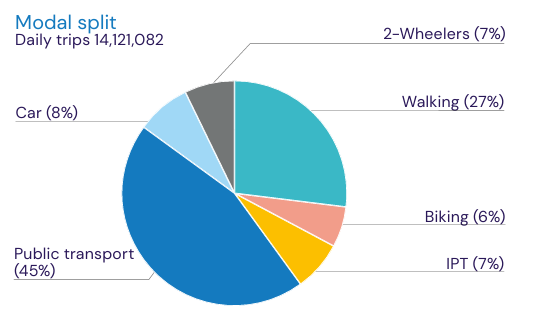
From the numbers in the report, the split inside public transport looks like this:
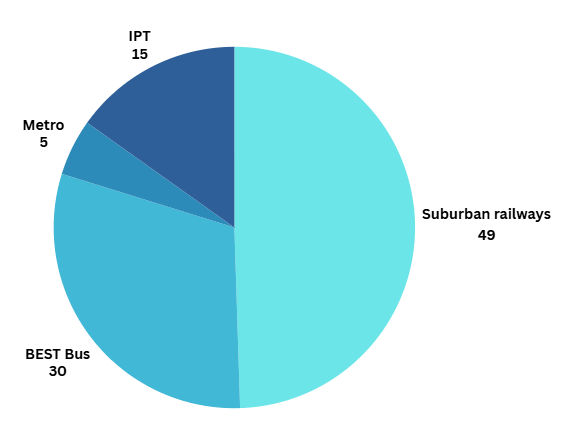
Unable to figure out if there’s a difference in the IPT (Intermediate Public Transport) with 7% share in the overall pie chart and the IPT with 15% share in the Public Transport pie chart or if it’s just a mess up. The sources are not hyperlinks, as is annoyingly common.
Alternatively, from The Automobilization of Mumbai: A Walking City That Privileges Cars
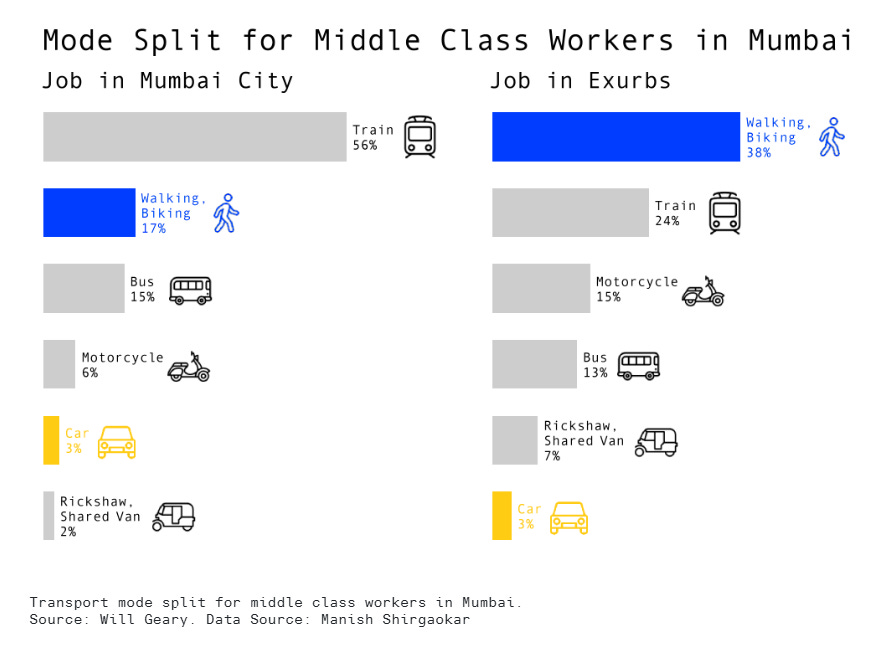
Private vehicles
Let’s get private vehicles out of the way first (I wish). This visual below from 2016 tells the story and by 2022 the private car + 2-wheeler road space share had gotten to nearly 80% in Mumbai. The graphic comes from a pretty slide deck by The Institute for Transportation and Development Policy (ITDP).
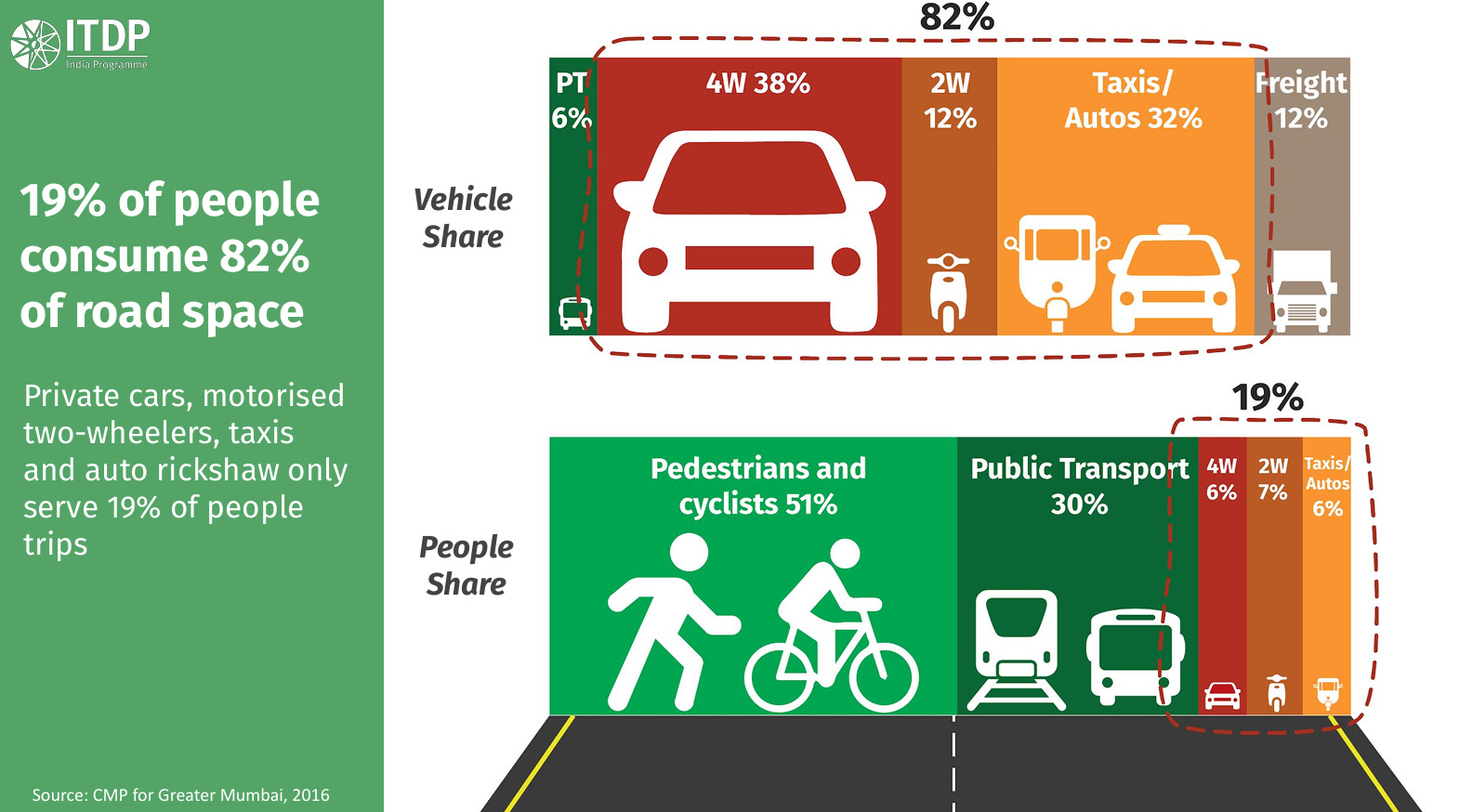
Again from The Automobilization of Mumbai: A Walking City That Privileges Cars:
But Mumbai continues to prioritize the car: Since 1999, in an attempt to ease congestion, Mumbai has built over 60 flyovers and several high-speed freeways, including the Bandra-Worli Sea Link, Eastern Freeway, Jogeshwari-Vikhroli Link Road (JVLR) and the Santacruz-Chembur Link Road (SCLR). Meanwhile, the city has no dedicated bus lanes, no regulations against roadside parking on arterial roads or in business districts and lacks basic provisions for pedestrians like footpaths and speed limits.
“Despite its large population, Mumbai actually has far fewer registered motor vehicles than Delhi, Bengaluru and Chennai” but “Mumbai has only about 2,000 kilometers of roads, less then 10% of Delhi's 28,508 kilometers of roads.”
The BEST Buses (10/10 for the acronym)
This part is going to be the longest because I know the least about it.
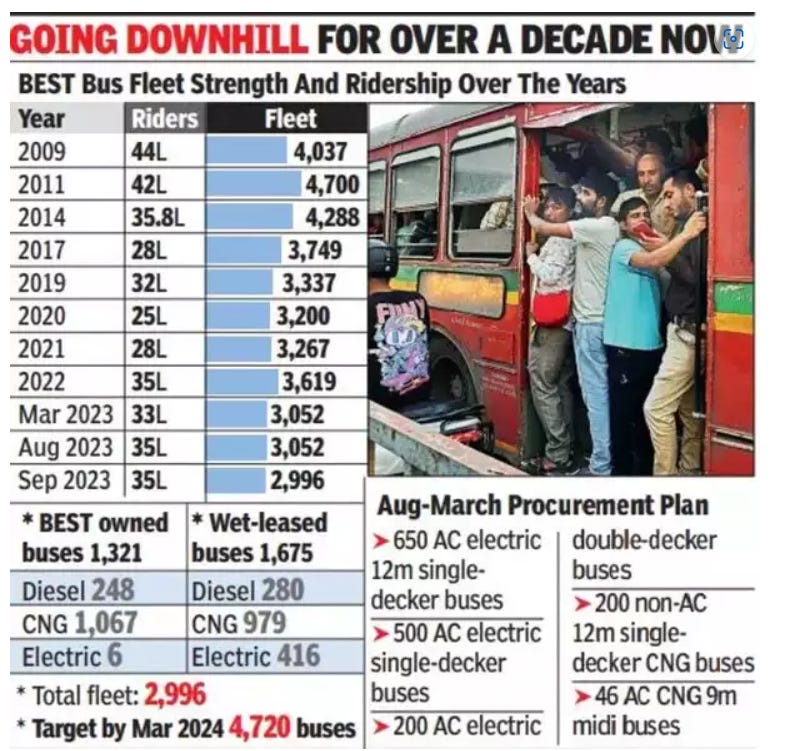
Times Of India provides the helpful graphic above which covers the dwindling numbers while the Hindu details the wet lease model and fears against privatization. It also states
In 2022, a tender was issued for procuring 2,100 wet-lease buses, but only 243 were delivered by August 2023. About 250 double-decker buses were also ordered by BEST, but only 50 were delivered.
I’m not sure what happens with these gaps in delivery.
Point 1 → Bombay doesn’t have enough buses, and the number has been reducing.
Finshots (Why is India’s public bus system in a mess?) captures the funding problem for buses nationally and also the quantity problem in a nutshell
While China has about 60 buses for every 10,000 people, India has a measly 4 buses that serve the needs of 10,000 folks. The bare minimum is 12. So, we’re way off the mark.
The Print reports the hesitancy of bus makers over government contracts and a dry-lease model
In addition to the finances, another problem in the latest tender was a “dry lease” under which the companies provide buses to the state transport corporations and the bus drivers and conductors are deployed by the state, the company officials said.
For BEST in particular, the Hindu again details an issue
… attributing BEST’s rising deficit to the cessation of cross-subsidy from its electricity division in 2005, which previously offset losses … He also points out that Section 134 of the Mumbai Municipal Corporation Act, 1888 obliges the BMC to subsidise BEST’s annual deficits.
Point 2 → State transport undertakings (STUs) bleed money and lack timely and sufficient financial support. They are borrowing huge amounts just to survive, them paying back further loans for expansion is doubtful.
Sidetrack, ET springed up a surprise for me when it stated
… the private sector controls more than 92% of the bus transport system in the country. The market share of the STUs is just 8%
On a national level the push has been for more electric buses rather than solving the quantity issue and in that too the private sector is being ignored. (Source)
Point 3 → While a lot more public sector run buses are needed, not considering the private sector in policy exposes only a small segment.
The Local Train (Aaoge tum kabhi)
While they have my heart, let’s get into the overcrowding issue with UN-ANSWERED CRIES OF PUBLIC TRANSPORT: MUMBAI SUBURBAN RAILWAYS AND THE QUESTION OF OVERCROWDING, WHAT SHOULD BE DONE?
Shockingly, a single 12-car train on Mumbai's suburban railway network has the capacity to carry 1,174 passengers. However, a single train with that many cars currently carries close to 6,000 passengers in one go.
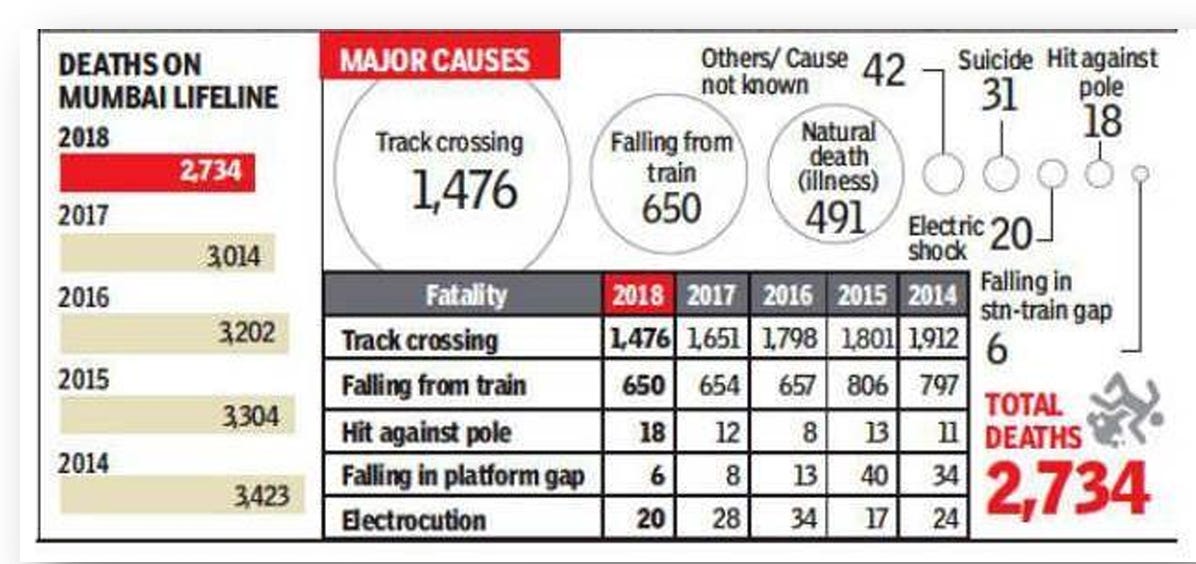
We talk too often about overcrowding as a matter of convenience while it’s a life and death issue. There is no sense behind the 600+ annual deaths from falling from train being acceptable other than the perceived value of life of those travelling.
The report, like everything else in the entire world, questions the Metro investment and has the following suggestions:
“Purchasing Double Decker Trainsets”
“Reasonable Expansion Further to Rural Hinterlands - Any expansions into new areas should have future capacity increases in mind.”
PPPs and/or contracting. I believe the lack of trust in the public sector to improve causes this option to come up in every problem’s solution.
The most recent news is the intention to move to an all-AC fleet. It is tough to call it a “plan” yet and has major ticket cost as well as other concerns.
Metro
National perspective first because every city has a metro project now:
As per Finshots (Is there a problem with India's Metro Rail), there is a use case for metro and it is in heavy corridors of 10km + commute, which most Indian cities don’t fulfill. From Finshots, “nearly 70% of the metro rides in India are less than 10km”
From a 2022 report by the Parliamentary Standing Committee on Housing and Urban Affairs
Most metro projects (except Delhi and Mumbai line 1) have seen low actual average daily ridership than what is required to breakeven. These metro projects include Bengaluru, Hyderabad, Chennai, Lucknow, and Jaipur. For instance, in 2020-21: (i) Bengaluru metro had an actual average ridership of 0.96 lakh against the required ridership of 18.64 lakh to breakeven, and (ii) Hyderabad metro had an actual ridership of 0.65 lakh against 19 lakh required to breakeven.
From a 2023 report by Transportation Research and Injury Prevention Centre - IIT Delhi:
It can be concluded that if a city decides to invest in metro system regardless of city size, it is for a small proportion of the total trips. Usually in cities having population of 2-3 million, proportion of trips which are potentially metro trips will be less than 5%. In future, with population growth, these cities may have a population around 5 million. However, in this case also the proportion of potential metro trips will not be more than 8%.
At the same time, “urban bus transport got only 3% of the funds allocated to Metro and HSR (High Speed Rail) combined.” (Source)
Mumbai (life in a) metro
From the above report by TRIPC-IITD again:
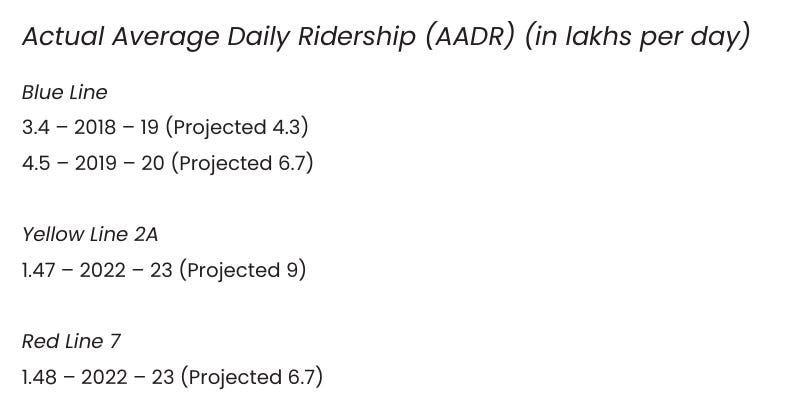
Metro line 3 has recently opened to “an average daily usage of around 20,000 passengers”. The Detailed Project Report (DPR) projected 1.3 million daily riders once the complete corridor is functional. Some of the problems reported:
Bandra Kurla Complex (BKC) was the main draw, but it can be a 20-minute walk to a lot of offices from the station.
“This segment primarily connects commercial zones. It does not serve the home-to-work commute, which constitutes a large portion of any city’s transport demand”
Last mile connectivity - “Most stations lack sufficient BEST bus and auto-rickshaw services”
“Metro fares, positioned as affordable for middle- and upper-income groups, stand in stark contrast to the city’s cheaper transport alternatives. Higher-income commuters, accustomed to the convenience of door-to-door transport, are less likely to switch from private vehicles.”
Marathi Manhattan
The comparison runs deep in my opinion, right up to the history with land reclamation. (Misc Reading: this plan to extend Manhattan and at the same time make it more climate change resilient.)
New York recently implemented congestion pricing in certain areas and saw 7.5% less or 273,000 fewer cars in the following week (Reuters).
From the NRDC (Natural Resources Defense Council):
Most importantly, funds generated by the congestion fee will enable the MTA to issue $15 billion in bonds and empower the transit agency to undertake critically needed capital expenditures to rebuild and enhance New York’s subway, bus, and commuter rail network, even if on a longer time horizon than originally planned.
ITDP has a comprehensive report on congestion pricing for Mumbai while the same pretty slide deck mentioned at the start captures a lot more points
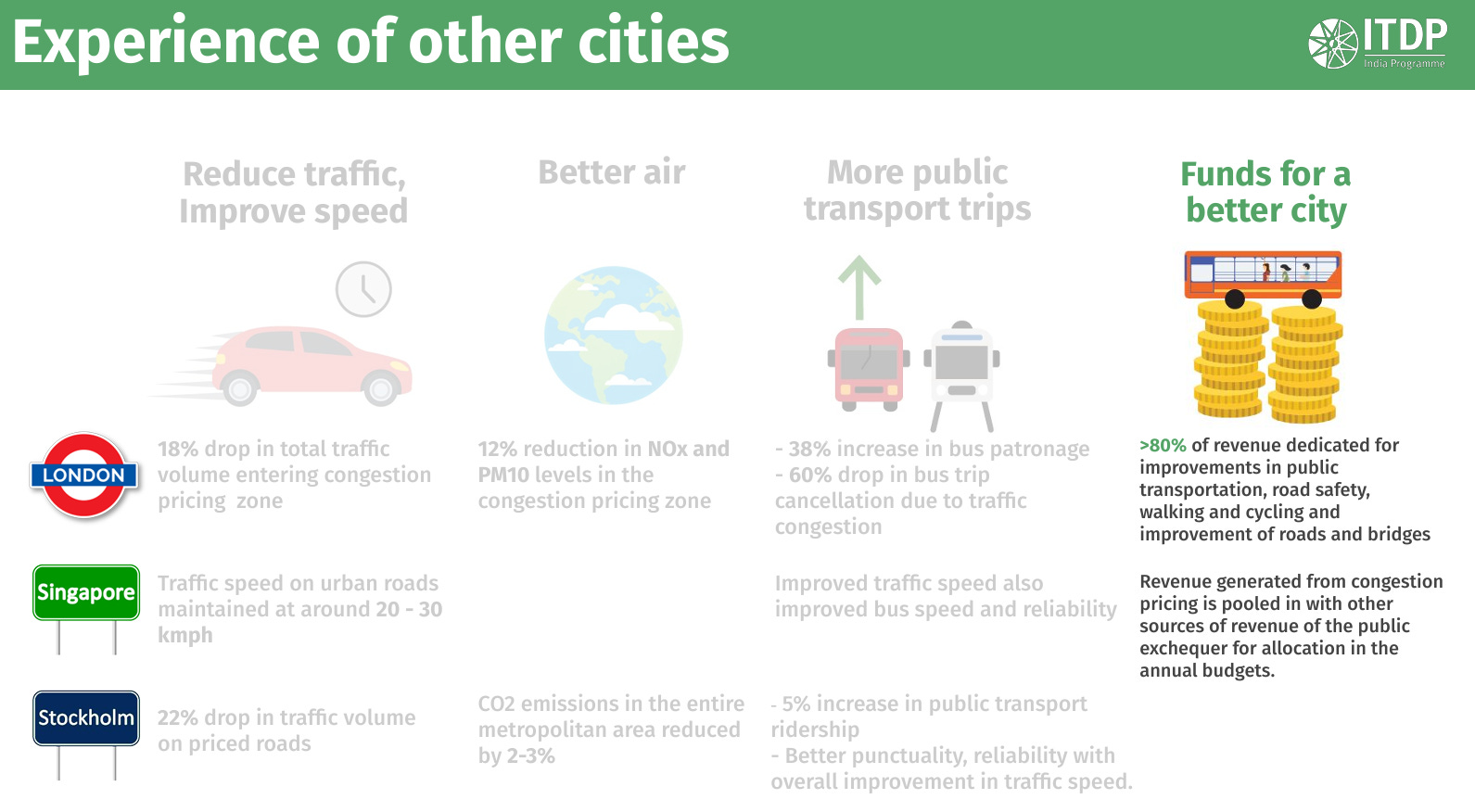
As per Times of India, we might see it happen this year. Fin.
.
.
.
.
And if a double-decker (BEST) bus crashes into us
To die by your side
Is such a heavenly way to die
(Source)
This was so interesting to read, made notes as well! It's crazy that public - private transport ratio is so skewed in Mumbai
Wow ! Interesting